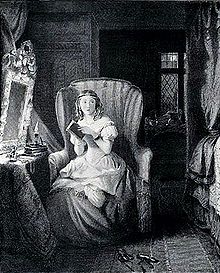
King Arthur’s Tomb (1914) by Florence Harrison.
Different eras had different concerns and therefore, different anxieties about King Arthur. In the twelfth and thirteenth centuries concerns focused on whether or not Arthur would literally return from the paradisiacal Avalon to restore his throne at Caerlon. Later, following the alleged discovery of Arthur and Guinevere’s tombs and the calamitous War of the Roses, the Tudors set to claim Arthur’s bloodline as their own, making his return figurative, with prophecy only satisfied once the descendants of Arthur reassumed the throne.
Later, Arthur’s military legacy was raised in the sixteenth century by British imperialists who saw his legendary conquests as a blueprint for a ‘British Empire’; claims that were countered by the scepticism of figures like Polydore Vergil, who expressed doubt on Arthur’s historicity to the ire of English commentators. By the eighteenth century Arthur was often invoked as a bulwark against the irrevocable effects of industrialisation and scientific progress. Though his political influence ultimately waned and died, he continue to inhabit the popular imagination as well as the nooks of rural British folklore.
Chapter 1: The Early Arthurs
King Arthur today is an archetypical figure: in the popular imagination he not only excels at war and politics, but is wise, pious, just, and even his failings, like his fatal wounding at Camlann, have the tint of glory about them. Abetted by his exemplary Knights of the Round Table, Arthur is a guarantor of prosperity and peace for his people, a seeker of holy relics and a staunch defender of Britain from enemies both foreign and domestic, human and supernatural. But, as Irish poet and critic T.W. Rolleston (1857 – 1920) notes in his Myths and Legends of the Celtic Race (1911) modern readers “will find in the native literature of mediaeval Wales little or nothing of all this–no Round Table, no Lancelot, no Grail-Quest, no Isle of Avalon, until the Welsh learned about them from abroad; and though there was indeed an Arthur in this literature, he is a wholly different being from the Arthur of what we now call the Arthurian Saga.”
Before delving into Arthur’s development, we must make a distinction between the historical and literary Arthurs, who are often conflated, with good reason but to confusing effect, with one another. Of the historical Arthur we can say almost nothing, except that he was, according to eighth century Welsh monk Nennius in his Historia Brittonum (The History of the Britons), a notable British warrior who helped defend Britain from the invading Saxon hordes sometime in the murky fifth century.
Nennius’ Arthur is a mystery: a war leader with an impressive military record but scant biographical details. This Arthur is lacking the kingship of later iterations (his position seems to be the result of a promotion or election) and is primarily famed for his military victories and an impressive (if dubious) body count at Mount Badon, where he slew nine hundred and sixty of the enemy. Despite his strength and prowess, Nennius’ Arthur is strictly a defender of Britain rather than the overseas conqueror of later Arthurian lore. It is from this rather indistinct ‘historical’ Arthur that the literary King Arthur would later spring, along with Guinevere, Lancelot, and the Holy Grail – the result of centuries of poetic invention and oracular transmission.
There are few mentions of the supposedly historical Arthur after Nennius: there is an allusion to his prowess in the Y Goddodin, and his victory at Badon and the fall of both Arthur and Medraut (later Mordred) at Camlann are catalogued in the tenth century Annales Cambriae (The Annals of Wales). Troublingly for proponents of an historical Arthur, sixth century British cleric Gildas, author of De Excidio et Conquestu Britanniae (On the Ruin and Conquest of Britain) and who marks the Battle of Camlann as occurring in the year of his birth, makes no mention of Arthur himself. Collected histories like the Anglo-Saxon Chronicle do not mention Arthur, and neither does Bede (672 – 735) in his Historia ecclesiastica gentis Anglorum (The Ecclesiastical History of the English People), while the Welsh tales that were emerging at the time were already steeped in the mythologising process that places him as the leader of a team of veritable super men and as a slayer of giants, dragons and witches.
Those invested in the historical Arthur have not let Gildas’ omissions derail them. W. Lewis Jones (1866 – 1922) asserted that Gildas’ De Excidio is “not so much a history as a homily” and that the chronicler is a biased source, given his tendency to demean –and even condemn– his fellow Britons.
Gildas belonged to a ‘Romanist’ party, and what the more or less unorganised Britons sought to do for themselves, and their independence, was to him but a decline upon savagery and selfish native pride. It did not suit his purpose to celebrate the name and virtues of any British prince and it is significant that, apart from Ambrosius –by birth, apparently, no less than by his training and sympathies, a thorough-going ‘Roman’– he does not mention by name a single British chieftain except as a target for his invective.
Welsh cleric Caradoc of Llancarfan (twelfth century) wrote a Life of St Gildas which claims King Arthur slew one of Gildas’ rebellious brothers, but that Gildas, in Christian fashion, forgave Arthur, who received penance. But according to Norman-Welsh chronicler Giraldus Cambrensis (c. 1146 – 1223) the Britons instead insisted that as a result of the slaying of Gildas’ brother a great history of Arthur had been destroyed by Gildas himself, who was their author:
The Britons maintain that, when Gildas criticised his own people so bitterly, he wrote as he did because he was so infuriated by the fact that King Arthur had killed his own brother, who was a Scottish chieftain. When he heard of his brother’s death, or so the Britons say, he threw into the sea a number of outstanding books which he had written in their praise and about Arthur’s achievements. As a result you will find no book which gives an authentic account of that great prince.
British philologist Lewis Thorpe (d. 1977) notes that “Apart from the fact that Gildas was born on the south bank of the Clyde, there is no evidence to support any of this,” though Giraldus gives himself some latitude by passing off the story as an invention of the Britons (“or so the Britons say.”)
Left there, Arthur might have slipped into obscurity and oblivion; a minor British hero celebrated in adventurous songs and poems but of no relevance to the wider British Isles or its people. It would be Welsh cleric Galfridus Monemutensis, or Geoffrey of Monmouth, (c. 1100 – c. 1155) with his Historia Regum Britanniae (The History of the Kings of Britain), completed in 1136, that would launch Arthur from an insular British hero to an international hero-emperor. Geoffrey expanded Arthur’s scope, bringing much of Europe under his dominion.
According to Geoffrey’s narrative, in centuries past Ireland and Iceland fell to King Arthur after their defending armies were routed, and the kings of Orkney likewise submit. In response, various European kings refortify their castles, afraid that he should invade. Unfortunately, their defensive measures entice rather than repel Arthur: “The fact that he was dreaded by all encouraged him to conceive the idea of conquering all of Europe.” He sails on Norway, slaughtering any who resist and pillaging the land until it and then Denmark fall under his rule. Gaul follows, and after nine years of warring, a triumphant Arthur holds court in Paris, divesting his conquered lands amongst his men before departing for Britain – and towards his dubious end at Camlann and passage to Avalon.
The publication of the Historia not only launched Arthuriana but also split it in two: so great was Geoffrey’s influence that from thereon Arthurian material would be classified as either pre- or post-Galfridian. Unfortunately, it is hard to untangle Geoffrey from his supposed sources and the numerous works that derived from him. Many Welsh manuscripts cannot be positively dated and it is supposed that in many instances Arthur was quietly incorporated into later editions. The Welsh were happy, for example, to subsume Geoffrey’s Historia into their own annals: a Welsh translation can be found in The Red Book of Hergest (c. 1382).
The earliest and most complete manuscript of The Mabinogion can be dated to the early fourteenth century, but the stories therein have not been conclusively dated, with scholars unable to agree on whether they precede or stem from Monmouth’s Historia. T.M. Charles-Edwards writes that scholars “are arguing about […] whether the man who wrote the Four Branches was indebted to French and Anglo-Norman literature and ways of thought and life, or on the contrary, belonged to the period of Welsh literature which preceded the Norman conquest of much of Wales.” Acts of appropriation like these were casually admitted by ‘Dafydd’, the author of Peniarth MS 50 (c. 1450), who describes how “Ryw ddirgeledic gydymddaith ydolgawdd ym drossi man betheu droganawl o ladin franghec a saesnec ynghhymraec/A mysterious companion besought me to translate prophetic fragments from Latin, French and English into Welsh.” Such a procedure was probably very common as bards travelled between countries and courts in the years following the Norman Conquest, slimming and expanding older stories with foreign interpretations and invention.
Arthur would be shaped into various colourful permutations throughout the intervening centuries, but the most contentious was his role as an explicitly Welsh hero who was destined to return from Avalon to relieve his people of the English who had displaced and harassed them for generations.
Chapter 2: The Sleeping Hero
“Many peoples in many lands,” John Morris wrote in The Age of Arthur, “dreamt of a distant hero who is not dead but asleep, who will one day awaken to rescue his people from conquest and oppression.” Ubiquitous among these sleeping heroes is an uncertain death, a famed but lost (or hidden) resting place, and a prophesised future peril for his country as well as its salvation.
In Norway similar legends surrounded the ill-fortuned Olaf Tryggvason (c. 960s – 1000) and similarly Harold Godwinson (1022 – 1066) was rumoured to have survived the Battle of Hastings, withdrawing from the battlefield and into the safety of an eremitic life. This legend was commemorated in a hagiography, the Vita Haroldi Regis (Life of King Harold), which claimed the Normans had invented the story of Harold’s demise because they feared “their destruction if the enemy should hear that he was alive.”
Edward II was also believed to have been deposited safely in Europe after his supposed death in 1327 and Edward III was rumoured to have met him in Antwerp in 1338. James IV of Scotland (1473 – 1513) was said to have been spirited away by supernatural interventionists at the disastrous Battle of Flodden and Edward VI (1537 – 1553) was also the subject of various prophecies concerning his early death and, once death had come for him, his alleged survival and passage to another country, including, in the style of other survival myths, an eventual heroic return.
Most of these survival legends petered out rather quickly and very few outlived their founding supporters, but some lived on with decidedly supernatural and folkloric elements. For centuries German folktales talked of Frederick I’s (1122 – 1190) slumber beneath the Kyffhauser Mountain, from which he and his knights will one day emerge to restore Germany to glory. Sebastian I of Portugal (1554 – 1578), last seen charging into the Moorish frontlines at the Battle of Alcacer Quibir, and whose body was never recovered, was long believed by the Portuguese to be slumbering in some otherworldly plane, awaiting the right time to return and restore his country to greatness. The Brothers Grimm also collected fables telling of Charlemagne’s (c. 742 – 814) slumber under a mountain, and Constantine XI Palaiologos (1405 – 1453) was said to have turned to marble, and will one day return to restore the Byzantine Empire. In Britain Thomas the Rhymer (c.1220 – 1298), Henry Percy (1364 – 1403) and Gerald FitzGerald (1456 – 1513) are said to slumber under the earth, awaiting the time to return and rule. In Ireland the mythical Fionn Mac Cumhaill is believed to sleep in a variety of caves, with James MacKillop writing that “There are more than thirty-five locations, in both Ireland and Gaelic Scotland, where Fionn and his men are supposed to be sleeping.” Other sleeping heroes proliferated throughout the entirety of Europe, appearing in Spain, Germany, France, Denmark, Hungary and even extending to Turkey and Russia.
The Welsh likewise developed a penchant for messianic national heroes throughout the Early Middle Ages, often exemplified in their various rebel princes. Welsh vaticinatory verse long foretold of the ‘Mab Darogan’ (son of prophecy) who would arise to restore his country and people. The ‘Mab Darogan’ epithet became attached to several notable Welsh rebel leaders and princes, including Cadwalader (d. 682) Gruffud ap Cynan (c. 1055 – 1137), Llywelyn ab Iorwerth (c. 1172 – 1240) Owain Lawgoch (1330 – 1378) and Owain Glyndŵr (c. 1349 – c.1415). Many of these ‘sons of prophecy’ died ignominiously: Lawgoch was assassinated by a confidant on order of the English Crown and Glyndŵr, though never captured, died in obscurity. When Llywelyn ap Gruffud, the last sovereign prince of Wales, was killed in 1182, Edward I (1239 – 1307) had his head sent to London where it was displayed and crowned with ivy in a mockery of the Welsh legend that a Welshman would be crowned there as the king of a restored Celtic Britain.
It may be no surprise then that the Welsh, beleaguered by disappointments, turned to Arthur, who, by merit of his victory at Badon and his stymying of the Saxons there, was the ideal British Messiah whose own vanishing from the world was no impediment to eventual victory. Arthur’s popularisation by the Historia created a hitherto unseen demand for the dissemination of Arthurian stories, allowing Welsh propagandists to seize his burgeoning fame and expound his legend as a sleeping hero who would return from Avalon to reclaim Britain for the Britons. While the cult of Harold Godwinson never inspired anything more than the imaginations of a few obstinate Englishmen and invoked very little but disdain from the Norman camp, and the supporters of other slain kings (like James IV) simply moved on with matters of succession, a figure like King Arthur, who existed between both historical and legendary thresholds, and whose example was esteemed even by the descendants of his historical enemies, would be harder to dismiss – after all, Arthur, unlike the Llywelyns and Owains, was not likely to ever have his head fixed atop a gate, nor have his reputation sullied by defeat in battle against contemporaneous enemies.
Geoffrey himself wrote that after Arthur’s wounding he would be attended to at Avalon, a mysterious Isle first mentioned in the Historia as housing the forge of Arthur’s sword Caliburn, but Geoffrey says nothing explicit of his survival until his addendum Vita Merlini in 1150. Geoffrey’s inclusion of Avalon inducted it into Arthurian lore, at least as a name, but it is only one in a long succession of Celtic otherworlds that he would have known about from older stories and mythologies. Pomponius Mela (active 43AD) wrote in his De situ orbis (Description of the World) of an island somewhere in the British Sea where nine Celtic priestesses who can “sanare, quae apud alios insanabilia sunt/cure what is incurable among other peoples” and who also “scire ventura et praedicare/know and predict the future” reside.
The seventh century Irish tale The Voyage of Bran, Son of Febal depicts the titular Bran’s odyssey to the Land of the Women, an isle said to be “Cen brón, cen duba, cen bás/Without grief, without sorrow, without death” and where food and drink are infinitely replenishable, descriptions that would mirror those of Avalon that Geoffrey gave in his Vita Merlini. Upon leaving, Bran and his men discover that the few days they passed at the island have in fact spanned centuries.
Unearthly islands also feature in The Voyage of St. Brendan (c. 900), where Brendan and his men seek an island where food, drink and clothing are unnecessary for survival and time is again a relative concept: when fifteen days are thought to have elapsed, they are told that a year has already passed without their consuming sustenance. Like the isle featured in the tale of Bran and future tales of Arthur, this place is “spacious, green, and exceedingly fruitful.” If Arthur had been transported to some isle populated by magical beings, a land of infinite prosperity where time obeys separate laws, allowing visitors to unwittingly pass months, years or centuries in what seemed to be mere moments, then it may be that Geoffrey intended that he land on one not too dissimilar from the many enchanted islands already present in Celtic legend.
It is also noteworthy that in the Vita Merlini and Preiddeu Annwn (The Spoils of Annwn, ninth-twelfth century) Arthur is ferried to Avalon by Barinthus, who serves as St. Brendan’s ship captain in The Voyage of St. Brendan. Fairy tales about such lands were still popular throughout the Early and Middle Ages. Giraldus Cambrensis wrote of a priest named Elidyr who, as a child, stumbled upon the Otherworld via a subterranean tunnel. Elidyr emerged into “a most attractive country, where there were lovely rivers and meadows, and delightful woodlands and plains” and was taken to meet the king of this idyllic place. After thieving from this strange world Elidyr was chased out and could never find the entrance again.
On the question of whether Geoffrey invented Arthur’s survival or adapted it from a prior tradition, Herman of Tournai (1095 – 1147) provides an interesting account of a visit to Bodmin in Cornwall, where he observed how the locals were “accustomed to arguing with the French about King Arthur” to the point where, in one instance, a local elderly man “began to bicker with one from our community […] saying that Arthur still lived.” This argument broke out into a larger confrontation where “many men rushed into the church with arms” and the spilling of blood was only averted by a cleric who kept the peace.
Herman’s account is interesting because it was written in the 1140’s but the story at Bodmin occured in 1113, some twenty three years before Geoffrey’s Historia appeared to set the post and pre-Galfridian watermark. William of Malmesbury (c. 1095/6 – 1143) also mentioned the Britons’ “many fables” concerning Arthur in 1125, detailing that “ancient ballads fable that he is still to come.” Further evidence of a pre-Galfridian Arthur survival myth is within the Englynion y Beddau (Verses of the Graves). The Verses, usually dated to the ninth or tenth century, is a record of the graves of various legendary heroes which maintains that Arthur’s resting place cannot be found. Interestingly, Modena and Otranto Cathedrals in Italy are also decorated with Arthurian imagery that dates somewhere between 1099 and 1165, and show Arthur astride a goat, a creature often associated with subterranean kingdoms. Sicily at the time was ruled by a Norman dynasty (Norman adventurers first appeared there in 999 and it fell under their rule by the early twelfth century) and these mosaics and carvings were likely inspired and transported by “oral tales […] brought over the Alps by itinerant storytellers and/or Norman craftsmen.” If the carvings do predate the Historia, then it would be compelling physical evidence for a widespread Arthur-in-the-underworld tradition. We can assume, as Geoffrey says in the Historia, that he is not the source of the Arthur survival myth, though he can certainly be called its most successful and renowned propagator.
Whatever the origins of the survival myth, it was Geoffrey who was explicitly targeted by critics; being the myth’s populariser made him just as bothersome as its source, if not more so. Arthur’s very existence however, despite his absence from vaunted records like Gildas’ and Bede’s, was never under scrutiny from Anglo-Norman or Scottish chroniclers. William of Malmesbury, who writes disdainfully of Geoffrey, still comments that the historical Arthur is “a man worthy to be celebrated” though, he deigns to add, “not by idle fictions, but by authentic history.” Giraldus Cambrensis, despite his limited faith in the veracity of the Historia, calls Arthur “that most renowned King of the Britons” whose memory will “endure forever”, but as for the claim that Arthur would rise again, Giraldus wrote:
The credulous Britons and their bards invented the legend that a fantastic sorceress called Morgan had removed Arthur’s body to the Isle of Avalon so that she might cure his wounds there. According to them, once he has recovered from his wounds this strong and all-powerful King will return to rule over the Britons in the normal way.
The Norman poet Wace, who translated the Historia into Norman as the Roman de Brut (1150), comments on the Britons’ belief that Arthur “is still there, the Britons await him, so they say and hope: he will return and live again” – his inclusion of “so they say and hope” being important qualifiers. Ultimately, Wace himself says that he adheres to the words of Merlin, who said that Arthur’s death would remain doubtful. Layamon, whose Brut (c. 1200) is the first of the English Arthur poems, also mentions the Britons’ belief in Arthur’s return and that he also defers to Merlin’s wisdom in the matter.
While Wace and Layamon were able to entertain doubt as storytellers, most chroniclers at the time fought back with the only weapon they possessed: derision. William of Newburgh (1136 – 1198) wrote that Geoffrey’s account was a lie, “promulgated either through an unchecked propensity to falsehood, or a desire to please the Britons, of whom vast numbers are said to be so stupid as to assert that Arthur is yet to come, and who cannot bear to hear of his death.”
An unofficial continuation of Geoffrey’s work, the Vera Historia de Morte Arthuri, even attempted to end the speculation around Arthur’s fate by revealing that the King received “no efficacious cure” from the efforts of Avalon’s physicians, and passed away as a consequence. Other English chroniclers like Robert Mannying of Brunne, John Hardyng and Thomas Castleford all mention the Britons’ belief in Arthur’s return and do not bring into question his existence, but they unequivocally state that the good king is dead. Mannying mocks that “if he life [live], his life is long.” In John of Trevisa’s translation of Ranulf Higden’s Polychronicon (1387) the Cornishman defends the historicity of Arthur on one hand and rubbishes the legends of his return with the other.
Scottish chroniclers, when they were not analysing the legitimacy of Arthur’s claim to the throne or boasting that he had in fact met his end to the Picts, likewise dismiss his return. The Welsh, meanwhile, were utilising Arthur’s popularity to its fullest, to the chagrin of English commentators. The author(s) of the Croyland Chronicle, compiled between the seventh and fifteenth centuries, stated that, “The truth is that, in those parts and throughout Wales, there is a celebrated and famous prophecy, to the effect that, having expelled the English, the remains of the Britons are once more to obtain the sovereignty of England.” The unknown author further writes that the Britons believed their time had come, and that they “used every possible exertion to promote its fulfilment.” A twelfth century Anglo-Norman chronicle writes that the Welsh “threaten us… openly they go about saying, by means of Arthur they will have [the island] back… They will call it Britain again.”
Chroniclers in France also chimed in: Walter of Châtillon (twelfth century) referenced the Britons’ popular faith “in their Arthur”, and Peter of Blois (c. 1130 – c.1211) wrote, perhaps sympathetically towards the Britons, in his debate poem Quod Amicus Suggerit of an agnostic Courtier who compares waiting for the afterlife to the belief in King Arthur’s return; in short, a fantasy:
We’ve never seen anyone
coming back from the world below –
we shan’t abandon certainties
for dubious tales
[…]
if you can believe in those,
you might as well expect the return
of Arthur with his British legions!
Though their general trappings are not unique, the Welsh tales of the sleeping hero have an eschatological tone to them in particular. Unlike other European narratives, where the sleeping hero and his retinue awaken by a rite performed by an interloper (such as drawing a sword or sounding a horn) the Welsh heroes are obstinate in their slumber if interrupted, and remain “asleep because the country’s need is not at its greatest and the people are not yet ready to receive and follow the redeemer.” When Arthur reawakens to repossess the Island and reinstate Caerlon, it will be at his peoples’ direst hour. This may refer to a prophecy in the Historia, which in addition to the prophecies of Merlin also contains an omen which comes after Arthur’s passing to Avalon and the subjugation of Britain by the Saxons. When Cadwalader, the last king of the Britons, sets his mind to reclaiming the country he is halted by an angelic voice that warns him the time is not right for the island to be returned to the Britons. That time would come, the voice says, but that time is not now.
Prophecy was cited as the authority concerning Arthur’s return, and the Arthurian prophet was Merlin, whom Geoffrey had drawn from the Welsh seer Myrddin. Benjamin T. Hudson writes that “The employment of prophecy as a genre for historical secular verse was not unusual in the Middle Ages. The model was provided by the Bible, with its insistence on the reverence due to prophecy and the sanctity of the prophets.” Merlin, like Nebuchadnezzar in the Book of Daniel, spends years roaming the forests in a state of madness before receiving clarity, but Merlin’s origin as a Welsh king who was struck mid-battle with madness and fled to the woods may also come from a prior tradition in the twelfth century Irish Buile Shuibhne (The Frenzy of Suidhne) which depicts a king’s flight to the woods and his long madness there.
Prophecy had long been purposed for religious, political or social causes. One of the earliest examples of prophetic literature, The Marduk Prophecy, originated in ancient Babylon. After a statue of their god Marduk was stolen and taken to the city of Elam, Babylon entered a period of decline and disaster. The Babylonians were said to have predicted that a “king of Babylon will arise” to restore the city, return Marduk, and punish Elam. The text is largely considered a propaganda piece, or vaticinia ex eventu (prophecies after the fact) for Nebuchadnezzar I (1124-1103 BC), who eventually liberated the statue of Marduk and defeated Elam.
As propaganda it is exemplary, turning an uncertain event (Nebuchadnezzar’s victory) into one mandated by celestial powers. Jesus Christ’s prophecies about the destruction of Jerusalem and its temples in the Gospel of Matthew is another cited example of vaticinia ex eventu, since Matthew was written after Jerusalem had already been sieged in 70 A.D. during the First Jewish-Roman War. According to D.N. Dumville the Welsh Armes Prydain Fawr (The Great Prophecy of Britain), a prophetic poem from the tenth century, likewise “takes its stance on well known truths of the present and past, prophesising these as future events and circumstances.” John Morris suggests that the Welsh plundered their own ancient histories and reinterpreted them for contemporary anxieties:
Since Welsh tradition had no history earlier than the fifth century, the poems of the sixth century became the starting point of historical verse and myth. The Merlin Cycle, the Armes Prydein and many other medieval poems plundered the older epics to weave mystic, nervous prophecies of an ultimate reconquest of the lost lands of England.
Another prophecy that was appropriated, this time from England by Wales, concerns Thomas Becket (c.1118 – 1170) who, one story goes, was visited by an angel who presented him with an oil to anoint the kings of England and who also foretold the domination of Europe by the Christian kings of England. Ian P. Wei writes that though the oil was used in the anointment of English Kings “until at least 1483 and probably until 1509” it did not appear “to have been exploited by Henry IV or his successors in support of their dynasty,” probably because of the similarity between Becket’s oil and France’s Oil of Clovis.
The blatant (and perhaps embarrassing) similarities between the oils did not stop the Becket prophecy undergoing an interesting transformation in Wales. In this version, it is Arthur who receives the anointing oil at Glastonbury, this time from the Virgin. British dominion is again prophesised, but notably, references to the ‘Reges Anglorum’ (‘the kings of England’) in the original become ‘brenhinoedd yr yns hon’ (‘kings of this island’) in the Welsh iteration. Dr. Ceridwen Llyoyd Morgan writes that:
It is ironic, and a testament to the skill of the redactor, that a prophetical tale once used in a foreign context should be adapted to carry a very different political message in Wales. From its continental beginnings, where it became part and parcel of the French monarchy, to 14th century England where it could be related to quite different political objectives, the legend of the holy oil finally in its Welsh form is translated into a lament for the loss of Welsh independence and a hope that one day the English yoke will be thrown off.
The ‘English yoke’ however had countermeasures of its own, and would address the Welsh prophecies and Arthur’s mounting popularity in the Plantagenet era by the protracted act of claiming him as their own.
Chapter 3: Arthur and the Plantagenets
The popularity of Geoffrey’s Historia saw Arthur’s literary character flourish in the twelfth century, transforming him from an insular British hero into an international hero-emperor. In Scotland, whose people were often harried by Arthur throughout his literature, John Barbour’s epic The Brus (c. 1375) mentioned him in positive terms:
Als Arthur, that throw chevalry
Maid Bretane maistres and lady
Of twelf kinrikis that he wan
And alswa as a noble man
[And Arthur that through chivalry
Made Britain his mistress and lady
Of twelve kingdoms that he won
And always as a noble man.]
His esteem burgeoned in France thanks to the influence of Welsh exiles who introduced “a great many ‘lais’ and Breton legends […] into French literature during the eleventh, twelfth, and thirteenth centuries” and he was beginning to be credited with historical deeds and was revered as a paragon: Alain Bouchart’s Grandes Chroniques (Great Chronicles, 1514) credits Arthur with the foundation of the first church at Notre Dame following his annexation of Gaul; in Petit Artus de Bretagne (Arthur of Little Britain, fourteenth century) the main character is named after the legendary king on account of his exemplary virtue. In John of Hauville’s (fl. c. 1184) poem Architrenius (c. 1184) the titular Architrenius is transported to a battlefield where the orders of good, led by Arthur and Gawain, are locked in bloody conflict with the forces of evil. Gawain tells Architrenius of the foundation of Britain by Brutus and introduces Arthur as “alter Achilles Arturus, teretis mense genitiva venustas/that new Achilles, the source of glory of the Round Table.”
Likewise, the lais of Robert Bicket (fl. c. 1175) and Marie de France (late twelfth century) contain many Arthurian characters, situations and allusions which their audiences were expected to understand. Chretien de Troyes began writing his Arthurian Romances circa 1170 beginning with Eric and Enide – a story likely based on the Welsh Geraint and Enid, though some scholars argue that the reverse is true. Eilhart von Berge and Gottfried von Strassburg (both late twelfth century) were bringing Arthurian stories, specifically Tristan and Iseult, into German for the first time, just as Béroul was doing in the Norman language. In the early thirteenth century Brother Robert, an Anglo-Norman cleric active in Norway, adapted many of the French romances into Old Norse, including Arthurian pieces inspired by Marie de France and Chretien. Jaufre, an Arthurian Occitan romance, was also popular throughout the Iberian Peninsula during the twelfth and thirteenth centuries.
Arthurian stories also appeared in Italy and Sicily, where they had the advantage of a ruling Norman elite that predated the English Conquest. The anonymously authored Floriante et Floret saw Arthur adventuring in Sicily and even located Avalon at Mt Etna. Guillem de Torroella (b. c. 1348) and Gervase of Tilbury (c.1150 – 1228) made the same connections to Etna, the latter having been in the service of Sicily’s Norman king. Dante Alighieri (1265 – 1321) would blame the stories of Lancelot’s affair with Guinevere as being the cause of Francesca da Rimini (1255 – 1285) and Paolo Malatesta’s historical affair and subsequently their torment in the Second Circle of Hell in his Divina Commedia (1320).
Unrelated but correlating relics also began accumulating an Arthurian association: the sword of St Galgano (1148 – 1181), which he plunged into a mound, awaiting a worthy to remove, became associated with the sword in the stone. In 1170 a certain Alanus (thought to be Alan of Tewkesbury) attested to Arthur’s popularity when he wrote: “Whither has not the flying fame spread and familiarised the name of Arthur the Briton, even as far as the empire of Christendom extends? Who does not speak of Arthur the Briton, since he is almost better known to the peoples of Asia Minor than to the Britanni?” Across Europe Arthurian literature was becoming an influence much as Homer’s Epic Cycle had been in the Mediterranean.
The reasons for this explosion in renown can be attributed to Geoffrey’s text and to the movements of Welsh and Breton bards who travelled throughout France and England. After the Conquest in 1066 many Breton lords were given English estates by William the Conqueror, thus spreading a new strain of Arthurian tales, already removed from the Welsh iterations, which were becoming popular in France. According to Roger Sherman Lewis these travelling minstrels were able to make “a livelihood by telling their tales, of which Arthur was the centre, with such verve that they were able to fascinate counts and kings who had not the slightest racial or political tie with the British hero.” John Morris agreed that “it is from the Norman stories that the legend grew, retold in succeeding ages in words and sentiment adapted to changing taste.” Richard Barber concurred, writing that “It is only after the Norman conquest of south Wales that we have evidence of the Arthurian stories in languages other than Welsh.”
Wace’s Roman de Brut (c. 1155) was the first substantial post-Galfridian Arthurian entry to appear. Wace, a Norman who ostensibly had contact with Breton poets and minstrels, incorporated into his account Arthur’s now-legendary Round Table, a device he claimed was already famed among the British. However, he also omitted Merlin’s prophecies, as did the English Layamon, whose Brut (c. 1200) ends with a promise that Arthur, upon his return, will aid the people of England. Subsequent English stories like The Avowying of King Arthur (c. 1375 – 1425), The Awntyrs off Arthure (late fourteenth century), Sir Gawain and the Castle of Carlisle (c. 1400) and Sir Gawain and the Green Knight (fourteenth century) all centred on idealised depictions of courtly life and chivalric conduct centred on Arthur’s court. The adventures therein often test the morals and mettle of various knights (with Arthur, as he is in The Avowying, sometimes serving as the presiding judge) as well as the chastity of their wives, and they usually end with a new inductee into the Knights of the Round Table and the country’s peace being upheld – there are no calls for rebellion, no purge of the English from the Isles, only stability and the constancy of Arthur’s reign. W.R.J. Barron comments in ‘Bruttene Deorling: An Arthur for Every Age’ that:
The sleight of mind by which Arthur becomes the Messianic hope of the Saxons who were his bitterest enemies was possible because the fundamental theme of the Brut is not culture but country, not race but land and the literary immortality of Britain’s darling was to be the common inheritance of all who made the land their home.
A pressing concern for the Anglo-Norman rulers of the time was not the proliferation of Arthurian material itself but the adoption of Arthur as a Welsh nationalist messiah figure. Arthur by this time had already entered the private hopes and beliefs of the English: the Fasciculus Morum, an English preacher’s handbook from the fourteenth century, makes reference to the souls of the perished joining King Arthur and his Knights in the Otherworld. Helen Fulton writes that “the English had appropriated their own version of Arthur as a king of Britain, and therefore of England, [but] to the Welsh he remained a Welsh king of the British nation before the coming of the hated Saxons.” A restored Britain, as far as the Welsh rebels were concerned, was not one that incorporated, but rather expelled, the nation of England. Arthur was attractive to English monarchs for reasons that went beyond his immense popularity; Geoffrey’s descriptions of Arthur as a great military leader and Christian who held power over the kingdoms of Britain as well as the fealty of Europe was the sort of hero-conqueror which English dynasties would long strive to model themselves after.
To settle the legends of Arthur’s return the Anglo-Normans would need to dispel the more unsavoury elements of his story –Avalon, his immortality– by producing a gravesite and a body. Problematically, there was no grave to plunder. William of Malmesbury had written briefly about the discovery of the grave of Gawain, “the noble nephew of Arthur”, before adding that the “sepulchre of Arthur is nowhere to be seen.” But at some point in 1191 or 1192 a breakthrough was made, and Giraldus Cambrensis visited Glastonbury Abbey to view the bones of Arthur and Guinevere, which had been miraculously uncovered there. “In our own lifetime,” he wrote, “Arthur’s body was discovered at Glastonbury, although the legends had always encouraged us to believe that there was something otherworldly about his ending, that he had resisted death and had been spirited away to some far-distant spot.” Giraldus wrote that the tomb of Arthur was emblazoned with a seal that read:
HIC JACET SEPULTUS INCLYTUS REX ARTHURIUS IN INSULA AVALLONIA, CUM WENNEVEREIA UXORE SUA SECUNDA
[HERE IN THE ISLE OF AVALON LIES BURIED THE RENOWNED KING ARTHUR, WITH GUINEVERE, HIS SECOND WIFE]
Giraldus’ conclusions were unequivocal: Arthur’s passage to the mysterious Avalon is a legend; he was in fact buried here, in Glastonbury, which he connects to Avalon by way of the Welsh name for the area, ‘Ynys Avallon’, as well as the tomb’s conveniently expositional inscription. The bones were so remarkable that they could only belong to a “veritable prodigy of nature” and were crisscrossed with multiple wounds and one “immense gash” that, Giraldus concludes, “caused Arthur’s death.” In 1216, twenty five years after viewing Arthur and Guinevere’s supposed remains, Giraldus wrote again of Arthur, again compounding his mortality:
Many tales are told and many legends have been invented about King Arthur and his mysterious ending. In their stupidity the British people maintain that he is still alive. Now that the truth is known […] The fairy-tales have been snuffed out, and the true and indubitable facts are made known.
Giraldus attributed the discovery of Arthur’s remains to King Henry II (1133 – 1189) himself, who had apparently learned of their location “from some old British soothsayer”. Giraldus relates that before his death in 1189 Henry informed the Abbot of Glastonbury about the location of the bones, which were allegedly exhumed in 1191. Henry’s motives, Lewis Thorpe writes, “would be obvious enough: the discovery would put an effective end to Welsh dreams that their hero would come back one day to help them in their resistance to the Norman Kings.”
It may be an important detail that Henry learned of the location of the grave from a Briton who had apparently given up the ghost and revealed that the stories of Arthur’s return was a myth founded on hope and self-deceit. Henry might have hoped that ascribing a British source to the story might throw the Britons into some disarray and doubt about their own veracity. Glastonbury itself was set to prosper from the find; the church had suffered significant damage in a fire in 1184 and to fund the repairs Henry was “variously reported to have promised either the total annual revenues of his West Country demesne or, more stunningly, the surplus revenues of the entire realm of England.” With his death and the accession of Richard the Lionheart (who preferred to funnel wealth from the abbeys of England to his cause in the Holy Land instead) Glastonbury found itself in a financial crisis, with its monks now taking to the road, “bearing their relics to the far corners of the realm in a desperate attempt to encourage gifts from the faithful that would at least partially compensate for the loss of Henry’s generosity.”
The discovery of the tomb of Arthur and Guinevere, two years after Henry’s death, seems too opportune to not be suspect. Whatever the suspicions, the important point was that the English had located Arthur’s bones and dispelled not only the mythical Avalon but Arthur’s survival as well. Arthur was then slowly consolidated not as a Welsh hero but an English one.
In 1190 Richard, about to embark on the perils of the Crusades and without a wife or heir of his own, designated his nephew, the son of his deceased younger brother Geoffrey, as the heir to the crown – the boy had been named Arthur by his mother, with Henry II’s consent. Prince Arthur (1187 – c. 1203) never lived to become king, dying in mysterious circumstances in 1203, but decidedly Arthurian arrangements had been made for his future. Richard, brokering peace and arranging political marriages with Tancred, king of Sicily (d. 1194), gifted him with a sword said to be Excalibur as part of an exchange that promised the young Arthur to one of Tancred’s daughters. Emma Mason points out in her essay ‘The Hero’s Invincible Weapon: an Aspect of Angevin Propaganda’, that Richard’s gifting of the most revered sword in British history seems over-generous: “A finely worked sword, with a reputed Arthurian provenance, would convey prestige to its current owner […] The possessor of Excalibur, as Caliburn came to be known, would be perceived as a born leader, destined to achieve great things.” We are left to deduce that the story of Richard’s gift, or the gift itself, was a fabrication, or we can presume that Richard’s heir was to re-inherit the sword after his marriage to Tancred’s daughter. Mason conjectures that the sword was merely decorative and worn only on formal occasions rather than during battle. Richard also adopted a dragon as his battle standard in the Holy Land, and Gervase of Tilbury (c. 1190 – 1228) claimed that its head was golden; in the Historia Uther Pendragon crafted a golden dragon as his standard, and Arthur’s golden helmet is also emblazoned with the beast in his battles against the Saxons. Richard’s example was followed by Henry III (1207 – 1272), who had a red dragon in the style of Cadwalader’s installed in the Abbey Church of Westminster and carried it into battle against rebellious Welshmen, as did Edward I.
Edward took many steps to quell not only Welsh rebellion but also to adopt Arthur into English chivalric culture, as did his relatives and kinsmen. Richard of Cornwall (1209 – 1272), a close relative of the King, “spent considerable sums building the remote castle at Tintagel, a place that offered neither strategic nor domestic benefits but that was, according to Geoffrey of Monmouth, the location where Arthur was conceived.” Arthur and Guinevere’s supposed bones were put on display again in Easter 1278 for the benefit of Edward and Queen Eleanor, who removed and inspected them before draping them in silks and reinterring them – Edward assuming the role of Arthur’s successor by paying reverence to his bones.
Besides cultural appropriation, there were also colonial and military aspects to these actions. His successor, Edward II, was born at Caernarfon Castle and was styled the Prince of Wales, likely in an attempt to link Wales’ imperial and independent past to its new role as a future dominion of England. After the conquest of Wales Edward was also gifted a coronet which once belonged to the rebel prince Llywelyn ap Gruffud that was dubbed ‘Arthur’s crown’. He also contrived to discover the body of Magnus Maximus, the legendary Emperor who had found Caernarfon after envisioning it in a dream, and who was attributed with the foundation of several Welsh dynasties and who was also, in some tales, even an ancestor of Arthur himself. The Annales Angale et Scotiae (c. 1312) modelled Edward’s wedding ceremony to his second wife, Margaret of France, after Arthur’s coronation as described by Geoffrey.
Edward was the subject of not only propaganda comparing him to Richard I and Arthur but was also the subject of prophecies. The thirteenth century ‘Catulus Linxeis’, of which only one copy survives, details (in Galfridian style, substituting human actors for animal counterparts) the many victories of the ‘Lynx’s Cub’ across both Britain and Gaul, the Lynx being commonly identified as Henry III and the cub, therefore, being his son Edward I. The text foretells the Cub’s transfiguration into a wolf, and then a boar, and finally a lion before his ascension to the stars once British hegemony over the Western nations has been secured and its Islamic enemies in the Holy Land overthrown.
Edward’s confiscation of various emblems of sovereignty from Scotland and Wales, such as the Stone of Scone and Arthur’s supposed crown, can be seen as a reclamation or reconstitution of Arthur’s empire, centred this time in England. He was certainly satisfied to rely on Arthur’s legends to justify his imperial ambitions. A letter from Edward to Pope Boniface in 1301 refers to Brutus’ subjugation of Albion and Arthur’s annexation of Scotland: “Item Arturus rex Britonum princeps famosissimus Scociam sibi rebellem subiecit, et pene totam gentem deleuit et postea quemdam nomine Anguselum in regem Scociam/Arthur, king of the Britons, that most famous leader, made subject to his authority rebellious Scotland, and destroyed nearly all its people and then appointed as king of Scotland one Angeselus.”
Ever since, Edward argued, Scotland had been a subject of the kings of the Britons and, as Arthur’s successor, Edward himself. But tales of Arthur informed opinion on both sides of the border: Edward was “regarded in Scotland as ‘the Covetous King’ of Merlin’s prophecy: after his death, the soothsayers foretold, the Celtic peoples would ‘band together, and have full lordship, and live in peace until the end of the world.’” Though no Celtic alliance materialised after Edward’s passing in 1307, the Scots could only have felt vindicated by his death and their proclamation of independence a few years afterwards. But as for the Welsh hope, Arthur had taken such root amongst the descendants of his historical enemies that in the fourteenth century chronicler Elis Gruffydd claimed that “they [the English] talk much more about him than we [Britons] do, for they say and strongly believe that he will rise again to be king.” Lesley Ann Coote writes that:
By the time of Edward’s death in 1307, the idea of the King of England as the prophetic hero who embodied all the political hopes, ideals and nature of the English people had taken firm root in the consciousness of many Englishmen. This hero, frequently indentified with Arthur redivivus, was the result of a process of accumulation which had been occurring from the twelfth century onwards, stimulated by an ever-growing demand for political prophecies.
Arthur’s court at Caerlon was also becoming the rod by which all future courts would measure themselves. Caradoc of Llancarfan detailed in the Brut y Tywysogion (Chronicle of the Princes) how in 1107 Cadwgan ap Bleddyn (1051 – 1111), a prince of the Kingdom of Powys, held a great feast, inviting all the great chieftains and gentry of the country as well as the best minstrels, the entire banquet designed to mimic the feasts of King Arthur. Edward I also hosted a ‘Round Table’ tournament at Nefyn, reputed to be where Merlin’s prophecies were discovered, and his enthusiasm for Arthurian relics and pageantry were inherited by his successors. Barbour’s The Brus includes a detail that Stirling Castle, held by the English for a decade until it was sieged before the Battle of Bannockburn, held an interesting artifact:
And his consaill thai haiff doyne
And beneuth the castell went thai sone
Rycht be the Rond Table away,
And syne the Park enveround thai
And towart Lythkow held in hy.
[And his council they have done
And beneath the castle went they soon
Right by the Round Table away,
And soon the Park encircled them
And towards Linlithgow held in high.]
Annalist Adam Murimuth (c. 1274 – 1347) wrote that Edward III widely instituted the Order of the Garter and the Round Table “in the same manner and condition as Arthur, formerly King of England, established it,” though one contemporaneous French account of Edward’s festivities was more suspect of his intentions, writing that at Windsor “[Edward] had planned to re-establish the Round Table and the adventures of chivalry, which had not been seen since the days of King Arthur. Yet in his heart he was thinking something quite different, which he did not show on the outside, for all this time he was readying a great fleet, and establishing a large garrison in one of his ports.”
Though Edward made no preparations of the sort until March of that year, the French depicted his Round Table event as a smokescreen for more perfidious intentions rather than out of enthusiasm for chivalry, high politics and solidifying personal relationships. The French in this case portray Edward III as being guilty of a false piousness. Regardless of how they were reported, such festivities were fashionable for centuries: Henry Herbert, 2nd Earl of Pembroke (1538 – 1601) held Arthurian parties at Ludlow Castle in 1596, his guests dressing themselves as Arthur’s knights.
Today, Arthur and Englishness have become inextricable. Glastonbury Abbey’s own website refers to Arthur as that legendary “English King”. As for the stories of Arthur’s Northern and Continental conquests, they would serve as useful propaganda in the future, but the next conflict would not centre on Arthur’s physical return, but on the accession of his bloodline to the throne of England.
Chapter 4: The Blood of Arthur, King Henry VII
Cadwaladers Blodde lynyally descending,
Longe hath bee towlde of such a Prince coming,
Wherfor Frendes, if that I shal not lye,
This same is the Fulfiller of the Profecye.
These words, written by John Leland as an ode to the triumphant Henry VII of England as he entered Worcester on a horse caparisoned with the arms of Cadwalader in 1486, ends for the people of Britain a centuries-long wait for the return of their long prophesied hero king, the Mab Darogan, or ‘Son of Destiny’. Henry carried the dragon standard into battle just as Owain Glyndwr had in 1400, but, unlike Owain, he succeeded in passing through Wales and overthrowing the last Plantagenet king, Richard III (1452 – 1485) at Bosworth.
Henry’s victory coincided with the posthumous publication of Sir Thomas Malory’s (d. 1471) Le Morte d’Arthur, the first substantial English Arthurian opus of the Middle Ages. Malory’s volumes would provide another leaping-off point for future Arthurian authors and poets, but if it aided Henry at all then it was by invoking the spirit of Arthur when Henry was doing much the same, instituting the office of the Rouge Dragon Pursuivant to honour Cadwalader the day before his coronation and highlighting his Arthurian heritage to justify his rule. Helpfully, his Welsh lineage was impeccable: he was a descendent of Llywelyn the Great’s seneschal Ednyfed Fychan; he was the blood of the one-time dominant prince in Wales, Rhys ap Gruffydd; and his grandfather Owain ap Maredudd ap Tewdwr had established the family brand by abandoning Welsh naming conventions and settling on a fixed surname – Tudor.
Owen Tudor, as he became known, was one of the few Welshmen who managed to rise above his station, becoming bodyguard (and later husband) to Catherine of Valois, the daughter of France’s King Charles VI and widow to Henry V (1387 – 1422). Social and political mobility was difficult for Welshman in England at the time. In retaliation for their uprisings, the English Parliament under Henry IV (1367 – 1413) passed a series of penal laws that severely restricted the rights of Welshmen in England: “They could not acquire property in land within or near the boroughs; they could not serve on juries; intermarriage between them and the English was forbidden; they could not hold office under the Crown; no Englishman could be convicted on the oath of a Welshman.”
Though foreign wars and domestic troubles created a demand for Welsh soldiers and therefore allowed for citizenship to be granted to a commanding few, the common Welshman found himself handicapped due to the discriminating laws for generations. When the Tudors assumed the throne of England under Henry VII they did so not as a new dynasty but as a continuing one – a restoration rather than an establishment; the kin of King Arthur back in power after hundreds of years of obscurity and near-insignificance as Welsh lords and princes.
But the Tudors were not unique in their ‘heroic’ Welsh bloodline. Welsh and Cornish dynasties had been claiming descent from Arthur for centuries in order to justify privileges and inheritances. One family of esteem in Mawgan, the Carminows, became entangled in legal difficulties with Richard le Scrope (c.1327 – 1403) when it was discovered both families bore the same coat of arms – the Carminows were able to argue that they inherited the heraldry from their ancestor Arthur, whereas Scrope could only trace his to the Norman Conquest. Henry VII’s wife, Elizabeth of York, was likewise related to Welsh royalty, her ancestor Roger Mortimer having married Gladys Ddu, daughter of Llywelyn ap Iorwerth. Her father and uncle, Edward IV and Richard III, could also claim descent from Llywelyn and other notables like Rhodri ap Merfyn (likewise known as ‘Rodri the Great’ and referred to in the Annals of Ulster as ‘King of the Britons’) and, eventually, as the legends go, Cadwalader, Arthur, and Brutus. The Wriothesley Garter Book, a compilation of Tudor armorials and genealogies assembled by Sir Thomas Wriothesley, corroborates the Yorkist Welsh lineage as well as that of the Lancastrians. Richard III might have proclaimed that the white boar adorning his livery represented Arthur, just as Henry identified himself with the red dragon of Cadwalader, but he made no claim that we know of, and it likely would have faltered when regarded against Henry VII’s more immediate Welsh ancestry and name. Richard’s own survival cult was brief. Edward Halle (1497 – 1547) reported that while Henry was campaigning in Wales “certain malicious and cruel persons … blased abrode and noised daily amongest the vulgare people that kyng Richard (which was openely sene dead) was yet liuyng and desired aide of the common people to repossesse his realme and roiall dignitie.” But rumours of his survival died as suddenly as they arose.
Upon Henry’s accession European poets and humanists were overcome with a Virgilian messianism that treated his reign as the beginning of a new golden age, England’s own Pax Romana, while Welsh bards saw his accession as the fulfilment of Merlin’s prophecies and the promise made to Cadwalader. A.G. Bradley writes:
The bards were of course in ecstasies; the prophecy that a British prince should once again reign in London –which had faded away into a feeble echo, without heart or meaning, since the downfall of Glyndwr– now astonished with its sudden fulfilment the expounders of Merlin and the Brut as completely as it did the audience to whom they had so long foretold this unlikely consummation.
Petrus Carmelianus (1451 – 1527), a Brescian poet, wrote that the War of the Roses had been so devastating that God himself had intervened by joining the Houses of York and Lancaster in the form of Henry’s son, the infant Prince Arthur (1486 – 1502). Bernard André (1450 – 1522), a friar, poet, and later tutor to the young prince, likewise commemorated his birth with a genethliacon, writing that the legend of King Arthur’s return had been accomplished with the birth of the prince. Giovanni Gigli wrote three pieces commemorating the young Arthur, one of which reads:
Henricum suboles, dudum promissa Britannis,
E celo veniens, nascere, magne puer;
Tolle moras; … Ecce ades!
[Offspring of Henries, for a long time now promised to the Britons, coming from Heaven, be born, great youth; have done with delays; … Behold! You are here!]
Sixteenth century England was rife with prophecies to one or two effects: there were those concerning succession in Scotland (which often had repercussions for England) and then there was, writes Tim Thornton, “the Welsh and Galfridian tradition usually associated with Merlin, which tended to focus on the conflict between Briton and Saxon, but also on crusade, Rome, France and Ireland, with a strong dose of dynastic instability and internal strife.” There was less emphasis on Arthur’s return since, as the Tudors and their supporters attested, that prophecy had been fulfilled.
Henry VII’s own interest in prophecy has been a matter of debate; his image had certainly been buoyed by it, and rumours that the Cheshire prophet known as Nixon had foretold his victory at Bosworth were popular enough, so we can deduce that he understood the importance of prophetic speech and its relation to political discourse. One manuscript, Arundel MS 66, which contains a collection of astrological and prophetic works, is believed to have been commissioned by Henry. Lesley Ann Coote asserts that the manuscript is “highly unlikely to have been produced speculatively, without prior knowledge of King Henry’s tastes” given its expensiveness. Included in the manuscript are varying prophecies, some attributed to Merlin, which stress the importance of peace with France (through the inheritance of the French crown by an English king) and the domination of Christianity in the Holy Land. The book itself is festooned with Tudor livery: the red dragon of Cadwalader replaces the more common imagery of the constellation Draco in a section on Ptolemy’s catalogue of stars, the red dragon being superimposed upon the green and white colours of the Tudors.

Whatever Henry’s relationship to prophecy and prophets, it would sour at the end of the fifteenth century. Italian astrologer William Parron, attempting to please the king on the death of his son Arthur, gifted him with a publication on the future fortunes of Henry VIII (1491 – 1547) which included, among others, prophecies concerning the future king’s long relationship with the Church and his blissful marriage. These prophecies would not embarrass Parron for some time; more immediate, and discreditable, was his prediction that the queen, Elizabeth of York, would live a long life – she died months later, in February 1503, after giving birth to Katherine Tudor, who also died on the birthing bed. The deaths of Elizabeth and Katherine, compounded by the recent loss of Arthur, devastated Henry, and Parron left the court in disgrace. Sir Thomas More, a young lawyer at the time of the queen’s death, scolded the astrologer in his A ruefull Lamentation (1503):
Yet was I late promised otherwise
This year to live in wealth and delice;
Lo, whereto cometh thy blandishing promise,
O! false astrology devinatrice,
Of God’s secrets and making thyself so wise?
How true is for this year thy prophecy?
The year yet lasteth, and lo now here I lye.
The Tudors would suffer more prophets during Henry VIII’s reign, most especially after Henry’s break from the Roman Catholic Church, which he justified in part by appealing to King Arthur’s defeat of the Roman legions on Continental Europe. The 1533 Act in Restraint of Appeals made the bold claim that “by divers sundry old authentic histories and chronicles, it is manifestly declared and expressed, that this realm of England is an empire, and so hath been accepted in the world.” This precipitated the Reformation and drew Henry the ire of his own people and prophets: old prophecies targeted at Henry IV were repurposed to target him, notably the ‘Prophecy of Six Kings’, a fifteenth century prophecy that depicted Henry IV as the ‘Mouldwarp’; a cowardly king that Merlin supposedly foretold would be overthrown and his kingdom divided.
In 1532, the famed ‘Holy Maid of Kent’, the prophetess Elizabeth Barton (1506 – 1534) soured relations between her and Henry when she prophesised that he would not live long if he annulled his marriage to Catherine of Aragon and remarried. Henry had supported Barton when her prophecies condemned heresy and rebellion against him but he quickly began a campaign of discrediting her that ended with her arrest in 1533, the supposed recantation of her prophecies, and her execution in 1534. In a final insult, Henry had her head displayed on London Bridge; making her the only woman afforded the dishonour. This did little to quell resistance. What began as a ‘whispering campaign’ against Henry became a full-fledged uprising. In 1536 the Yorkshire uprising known as the ‘Pilgrimage of Grace’ broke out in retaliation for Henry’s break from the Roman Catholic Church and the rebels, like many before them, turned to Merlin for their battle cries and vociferations, slandering Henry as the Mouldwarp.
Henry did have his defenders. Wilfrid Holme (d. 1538) wrote in his poem ‘The Fall and Evil Success of Rebellion from Time to Time’ (written in 1537 but not published until 1572-3) that the Mouldwarp was believed, erroneously in his view, to be Henry VIII on the account of seditious prophets:
A prophet came (a vengeance take them all!)
Affirming Henry to be Gogmagog
Whom Merline doth a mouldwarp ever call,
Accurst of God, that must be brought in thrall
By a wolf, a dragon and a lion strong,
Who should divide his kingdom them among.
The identification of Henry with the cowardly Mouldwarp who abandons England to his enemies spread amongst Catholic sympathisers, the clergy and anti-Reformation rebels. To counteract this, his chief minister Thomas Cromwell (1485 – 1540) took advantage of the Treasons Act 1534, which prohibited slander against the king in written or oral form, and began collecting prophecies in order to convict those who had, in the eyes of the government, violated these sections of the Act. John Hale, vicar of Isleworth, was interrogated in 1535 having been accused of calling Henry “the Molywarppe that Merlin prophesised of.” Hale admitted in his deposition to the Privy Council that sometime in 1533 he had been shown the prophecies of Merlin, and despite his disavowals of anti-Henry sentiment (and several pleas about his infirmity) he went the scaffold. In 1537 Richard Bishop of Bungay in Suffolk was punished for making vague references to the Mouldwarp prophecy and in 1538 John Dobson, vicar of Muston, Yorkshire, was executed for telling his congregations that Henry, in accordance with Galfridian prophecy, would soon be overthrown. English antiquarian John Hooker (c. 1527 – 1601) provided an account of an Exeter city attorney who was put to death in 1539 for discussing prophecies and Henry’s possible connection to the Mouldwarp.
In 1542 the Tudors outlawed conflating Henry with the Mouldwarp, including but not limited to the propagation of prophecies to that effect, and later legal statutes in the Elizabethan era prohibited any “prophesying, witchcraft, conjuration, or other like unlawful means” of predicting the queen’s death. Still, though imitations and forgeries were easily spotted and mocked by elites they were widely accepted by the public at large. Learned Elizabethans were also slow to dismiss prophecies that were legitimately ancient and new interpretations of old prophecies also tended to suffice. New regulations were frequently introduced, and forbade:
Any fonde fantasticall or false Prophecye upon or by thoccasion of any Armes Fieldes Beastes Badges or suche lyke things accustomed in Armes Cognisaunces or Signettes, or upon or by reason of any Time Yere or Daye name Blodshed or Warre, to thintent therby to make anye Rebellion Insurrection Dissention losse of life or other Disturbance within this Realme and other the Quenes Dominions.
Thomas Howard, 4th Duke of Norfolk (1536 – 1572) who conspired to overthrow Elizabeth in favour of her cousin Mary, Queen of Scots (1542 – 1587) in 1572, was accused at his trial of having been inspired by variants of the Merlinian prophecies that plagued Henry VIII. The monarchy’s attitude toward prophecy, especially prophecy criticising the conduct of the crown or the wellbeing of royals, was clear – Thomas Howard was executed and his titles and lands made forfeit. His younger brother Henry Howard, 1st Earl of Northampton (1540 – 1614) later wrote a polemic titled Preservative against the Poison of supposed Prophecies condemning “certain busy-bodies” who “with limned papers, painted books and figures of wild beasts and birds, carry men from present duties into future hopes.” Though astrologers like Richard Harvey (d. 1630) managed careers in writing prophecy throughout Elizabeth’s reign they did so at the expense of suspicion, ridicule and contempt.
Chapter 5: Arthur and the Empire
Prophecy had become a bane for the Tudor dynasty, but there were other aspects of the Arthurian legend to mine. The blood of Arthur was securely on the throne, and no counter-prophecy had managed to dislodge it. The time had come for the monarchy of England to reclaim those lands and kingdoms conquered by their ancestor, Arthur himself. The fantastical stories of Arthur’s European conquests and overseas excursions beyond the limits of the known world would find themselves utilised in the sixteenth century not to celebrate an empire now gone, but lay the blueprints for an empire to come – specifically, a British Empire, with the legendary Brutus as its founder and Arthur its first great emperor.
The reign of Henry VIII had already laid the groundwork for this empire, declaring as it broke from the Papacy in 1533 that England was an empire owing to its descent from Brutus and the rejection, and then defeat, of Rome by Arthur. With England independent from the Papacy all that remained was the absorption of Wales, Scotland and Ireland into one united Britain. Two statutes in 1535 and 1542 incorporated Wales into England, abolishing marcher lordships and reorganising the marches into shires. Parliament also created new counties, extended English law into those areas, and forbade Welsh speakers from political or public office should they not first and foremostly speak English (a provision not repealed until 1993.)
Though historians have viewed these laws as an attempt to eradicate Welsh identity and culture, the Welsh gentry at the time offered no resistance to the legislation, since the new laws bestowed on them the same rights and privileges as their English peers. Welsh antiquarian George Owen (1552 – 1613) wrote in A Dialogue of the present Government of Wales (1594) that Wales had suffered under the laws of Henry IV but were vindicated by Henry VII’s accession to the throne on account of his Welsh heritage, and vindicated further by Henry VIII’s “special care of his native country of Wales” and the “most pleasant laws” he enacted which made “the subjects in Wales equal in freedom with the subjects of England.” It’s certain that these laws, which in retrospect are considered to have diminished Wales’ identity, were widely accepted by Welshman not only because it brought them into standing with Englishmen but because they were enacted by a monarchy that was considered, in Wales, to be Welsh. The Welsh nobility may have viewed the annexation to be one in which Wales was master, and the abolishment of the marches mere modernisation. Philip Schwyzer notes that “There was cause for rejoicing among the English as well – for if they and the Welsh were now one and the same, they too were entitled to call themselves Britons.”
Despite the unity of Wales and England, tensions with Scotland persisted. The King’s Printer under Henry VIII, Thomas Berthelet (d. 1555) argued that the kings of Scotland had historically “always knowleged the kynges of Englande [were] superior lords of the realme of Scotlande” and that the Scots must not only be subservient to their neighbour but indivisible from it as well. Centuries earlier Giraldus Cambrensis had displayed the same attitude when discussing Welsh and Irish rebellions in his Topographia Hibernica (c. 1188) where he referred to the many uprisings as being divisive, as though Wales and Ireland were inextricable parts of England. Berthelet relinquished his post after Henry’s death to Richard Grafton (c. 1511 – 1572) who likewise campaigned for Scotland to join itself with England in political union to restore “the only supreme seat of thempire of greate Briteigne.” Grafton argued that the fifth century Romano-Brit Ambrosius Aurelianus, who had been refitted in Geoffrey’s Historia as an uncle of King Arthur, had killed Hengist with his brother Uther Pendragon, and thusly “this Realme was delivered from the tyranny of the Saxons, and restored to the whole Empire & name of greate Briteigne.” The incursions into Scotland led by Protector Somerset during Henry VIII’s ‘Rough Wooing’ was characterised as a ‘British’ mission with the aim of rejoining Scotland with a ‘Great Britain’ of which it was historically once a constituent part, with England as its core. Scots, by resisting, were battling what Grafton called “the mother of their awne nacion.”
There was opposition however towards the acceptance of Arthuriana into Elizabeth I’s court. Her tutor and secretary, Roger Ascham (1515 – 1568) dismissed the Morte d’Arthur in particular as a work of perversion. “The whole pleasure of [that] book standeth in two special points: in open man slaughter and bold bawdry […] That is good stuff for wise men to laugh at, or honest men to take pleasure at: yet, I know when God’s Bible was banished at the court, and Morte Arthur received into the prince’s chamber.” Despite Ascham’s distaste for the material, Elizabeth still indulged in the Tudor relation to Arthur. Edmund Spenser (c.1552 – 1599) detailed Brutus’ subjugation of the island in The Faerie Queene as well as Elizabeth’s relation to various esteemed British heroes:
Thy name O soueraine Queene, thy realme and race,
From this renowmed prince deriued arre,
Who mightily vpheld that royall mace,
Which now thou bear’st, to thee descended farre
From mighty kings and conquerours in warre,
Thy fathers and great Grandfathers of old
Spenser also affirmed the Tudors’ British lineage and right to the throne, the union between Wales and England, the laying down of the arms of rebellious forces, and the prophesised rule of a “royall Virgin” who is explicitly Elizabeth herself:
So shall the Briton blood their crowne again reclame,
Thenceforth eternall vnion shall be made
Between the nations different afore
And sacred Peace shall louingly persuade
The warlike minds, to learne her goodly lore.
In 1575 she spent some days at Kenilworth Castle where, upon approaching the gates, she was heralded as the descendant of Arthur and partook in public games where she repelled Sir Bruce Sans Pitie (described by Malory in the Morte d’Arthur as the most villainous knight alive) from assaulting the Lady in the Lake. Frivolities aside, Arthur’s exploits were also inspiring broader imperial thought at court. Sir Roy Strong observed that from 1579 on, “There appears the first of a long series of portraits of Elizabeth which introduce a heavy overlay of imperial pretensions stemming from maritime power and from a reassertion of dominion based on the descent of the House of Tudor from the imperial stock of Troy and on the conquests of King Arthur.”
John Dee (1527 – 1608/09), an advisor to Elizabeth who also qualified as a mathematician, astronomer, and occult philosopher, took Arthur’s foreign exploits very seriously. Dee is often said to have originated the term ‘British Empire’, and while that may not be true (Welsh antiquarian Humphrey Llywd had called Arthur’s domain a Britannicum imperium in 1572) the misapplication is not a miss-association – Dee was a thoroughgoing and committed imperialist who proclaimed Elizabeth was due “the royalty and suzerainty of the seas adjacent, or environing this Monarchy of England, Ireland, and (by right) Scotland, and the Orknayes allso.” Dee wrote to the queen, insisting that she held a legitimate claim on the lands seized by Arthur, who, according to history:
Not only Conquered Iseland, Groenland, and all the Northern Illes compassing unto Russia, But even the unto the North Pole (in manner) did extend his Jurisdiction: And sent Colonies thither, and into all the Isles unto Scotland and Iseland, whereby yt is probable that the late named Friseland Illand is of the Brytish ancient discovery and possession: And allso seeing Groenland beyond Groenland did receive their inhabitants by Arthu, yt is credible that the famous Iland Estotiland was by his folke possessed.
British imperialists like Dee used Geoffrey’s Historia as their basis, but other texts had long propagated the legends. The thirteenth century Leges Anglorum Londoniis Collectae details Arthur’s conquests of Greenland, Vinland, and the North Pole, as did Jacob Cnoyen’s (supposedly lost) Gestae Arthuri in the fourteenth century. David Armitage writes that the fundamental idea of a British Empire “lay, on the English side, in the British history of Geoffrey of Monmouth and, in the Scottish rebuttals, the humanist historiography of Polydore Vergil.” Vergil (c.1470 – 1555), an Italian scholar living in England, expressed incredulity in his book Anglica Historia that the British could believe that Arthur “subeewed Scotlande with the Ilyes adjoyninge; that in the teritorie of the Parisiens hee manfullie overthrew the Romaines, with their captain Lucius; that he did depopulate Fraunce; that finallie hee slewe giaunts, and appalled the hartes of sterne and warlike menne.” Vergil was likewise critical of the existence of the author of the British nation: Brutus, who was never mentioned by Livy or Dionysus Halicarnassus despite his legendary lineage and historical importance. Vergil also charged that Britain, like many nations before it, had simply mythologised its history to derive its own beginnings from the gods.
He also threatened to undermine the Glastonbury story, arguing that Arthur’s burial there was impossible, since the monastery was founded after his supposed death, though William of Malmesbury claimed that a church existed there as early as 166 A.D., founded by missionaries in the time of Pope Eleutherius, and was much famed, containing the bodies and relics of innumerable saints as well as “some ancient enigma” that he could not elaborate on. He also described the pyramids that according to Giraldus flanked the graves of Arthur and Guinevere. Upon these pyramids could be read (though not perfectly understood) “some traces of antiquity.” William, writing before Arthur’s grave was located there, deduces that the pyramids contain the remains of bishops and other local figures. Arthur’s bones evaded the era of scientific scrutiny – his grave had been plundered and lost during Henry VIII’s Dissolution of the Monasteries.
Vergil was not only lambasted for his perceived attack on British antiquity but also accused by notables like Humphrey Llywd, Sir Henry Saville and the doctor John Caius of destroying a great deal of manuscripts that he had allegedly plagiarised and pillaged. Caius in particular published a tract which declared that it was “not only reported, but certainly known, that Polydore Vergil, to prevent the discovery of the faults in his history, most wickedly committed as many of our ancient and manuscript histories to the flames as a wagon could hold” – an allegation not dissimilar from that levied against Gildas, and one that John Dee also repeated in his books. For Dee, Vergil’s attack on Arthur’s historicity was an attempt to delegitimatise the nascent British Empire’s claim to overseas colonies and other imperial endeavours. Published rebuttals and attacks on Vergil throughout the century included John Leland’s Assertio inclytissimi Arturii Regis Britanniae in 1544, Sir John Prise’s Historiae Brytanicae Defensio in 1573 and astrologer Richard Harvey’s Philadelphus, or a Defense of Brutes, and the Brutans History in 1593.
One defender of Vergil’s reputation was English antiquarian William Burton (1575 – 1645), who contested that Vergil’s most voracious critics had attacked him “not, as I conceive, for any just cause, but for that he, being an alien, should be graced with such a matter of charge, which most properly had belonged to a native of the land.” Secondly, Burton insisted that Geoffrey of Monmouth was roundly acknowledged, even in Britain, to have somewhat hyperbolically overstated the achievements of the Britons, and that Vergil was not assaulting British history, but merely Geoffrey’s extrapolations and additions.
Despite the attacks on Vergil, his opinion of Arthur was becoming commonly accepted, and by the time of James VI and I (1566 – 1625) of Scotland and England Arthur was becoming steadily unfashionable. Michael Drayton (1563 – 1631) when attempting to endear himself to James’ court, was mocked and dismissed when his Poly-Olbion (1612) tried, increasingly against vogue, to place Arthur in an historical context. “Ignorance had brought the world to such a pass/As now, which scarce believes that Arthur ever was,” he lamented. King James however was happy to incorporate Arthuriana into his court masques and to adopt the ‘British’ mission and absorb England and its neighbouring countries into one united state: “For even as little brookes lose their names by their running and fall into great rivers,” he said, “so by the conjunction of divers kingdoms into one, are all these private differences and questions swallowed up.” James’ supporters also had a tendency for the Arthurian, claiming that his name ‘Charles James Stuart’ was an anagram of ‘Claimes Arthures seat’ and that James, as a great-grandchild of Henry VII, was destined to unite Scotland and England as they were in Arthur’s time. Ben Jonson’s (c. 1572 – 1637) The Speeches at Prince Henry’s Barriers (1609) has King Arthur praise James for unifying the crowns of Scotland and England:
Merlin’s mystick prophesies are absolv’d
In Britain’s Name, the Union of this Ile,
And claim of both my Scepter and my Stile
However, there was not enough traction for a union of the parliaments at the time; historian Henry Spelman (c. 1562 – 1641) argued in Parliament that England would be “buried in the resurrection of Albion or Brittania” and all to “restore the memory of an obscure and barbarouse people.” This was a difference in attitude from that of Henry VII, who had stated, when objections were made to the marriage of Margaret Tudor (1489 – 1541) and James IV of Scotland, that Scottish assumption to the throne of England would simply see Scotland absorbed into England and the rebirth of Britain, rather than mere Scottish dominion of English properties.
Politically, Arthur was still paid lip service, but his inclusion seemed to hinge on tradition rather than conviction, and though he still inhabited literature and other works, major poets and playwrights were avoiding his material, and the lesser artists vaunted him on one hand whilst asking audiences to allow their dreams of an Arthurian British empire to rest in deference of the status quo. In 1622 The Birth of Merlin was performed in London, written by dramatist William Rowley and attributed, in part, to William Shakespeare, though the Bard’s involvement has been dismissed by scholars (another Shakespearean forgery, Vortigern and Rowena, would appear in 1797). The play notably ends with Merlin prophesising to Uther Pendragon that the Saxons will populate Britain, and he then foretells Arthur’s birth, reign, and victories, but adds that he will die before picking a suitable heir to his kingdoms. Uther replies that Fate must be obeyed no matter its decree, and despite the dissolution of British hegemony and the eventual Saxon, and English, dominance, Arthur will always be remembered by posterity. As for his influence on foreign and imperial policies, other propellants were at hand: competition with other burgeoning European empires like Spain and Portugal saw exploratory missions become ones of settlement, and England’s (and later, the United Kingdom’s) advances in Arts and Sciences provided the justification for subjugating and ‘civilising’ the peoples of Ireland and the expanding New World, or, as Ephraim Chambers called them in his Cyclopaedia (1728), “the savages of Canada or the Cape of Good Hope.”
Arthur might have seen a resurgence during the seventeenth century had one of its foremost poets turned his attention to him. John Milton (1608 – 1674) toiled over the Matter of Britain for some time, making reference in his early work of “Arturumque etiam sub terris bella moventem/Arthur setting wars in motion even beneath the earth” and the “Aut dicam invictæ sociali fœdere mensæ, Magnanimos Heroas/high souled heroes in the virtuous friendship of the Invincible Table” but Milton, despite having planned an Arthurian epic, never composed one. He seemed to toil for some time on the subject matter: “what king or knight before the Conquest,” he wrote, “might be chosen in whom to lay the pattern of a Christian hero?” In his History of Britain (1670) he expresses frustration with Arthur’s historical record and that chroniclers like William of Malmesbury knew “no more of this Arthur five hundred years past, nor of his doings, than we, now living” and that “who Arthur was, and whether ever any such reigned in Britain, hath been doubted heretofore, and may again with good reason.” By this point Milton seemed to have set Arthur aside indefinitely, writing that aside from Monmouth’s account the great, European-conquering Arthur was utterly absent from other domestic and foreign histories. “Others of later time have sought to assert him by old legends and cathedral regests,” he wrote, “But he who can accept of legends for good story, may quickly swell a volume with trash, and had need be furnished with only two necessaries, leisure and belief.” In Book 9 of Paradise Lost Milton excuses his lateness in writing the Satanic epic, asserting that he had been momentarily distracted by wasteful and invented tales of chivalric knights but had now turned his attention to a greater purpose:
Since first this subject for Heroic Song,
Pleas’d me long choosing, and beginning late;
Not sedulous by Nature to indite
Warrs, hitherto the onely Argument
Heroic deem’d, chief maistrie to dissect
With long and tedious havoc fabl’d Knights
In Battels feign’d; the better fortitude
Of Patience and Heroic Martyrdom
Histories were increasingly distancing themselves from the fanciful claims of the past: no longer could a historian write of a giant-infested origin for the British Isles, or of the coming of Brutus and the reign of Arthur, without inviting serious ridicule. While there were acknowledgments that Arthur must have derived from some distant, obfuscated truth, it was accepted that the histories of the Britons were colourful fabrications and exaggerations. In his 1778’s The History of England Scottish philosopher David Hume wrote that:
[The Britons] applied for assistance to Arthur, prince of the Silures, whose heroic valour now sustained the declining fate of this country. This is that Arthur so much celebrated in the songs of Thaliessin, and the other British bards, and whose military achievements have been blended with so many fables as even to give occasion for entertaining a doubt of his real existence. But poets, though they disfigure the most certain history by their fictions, and use strange liberties with truth where they are the sole historians, as among the Britons, have commonly some foundation for their wildest exaggerations.
The only surety Hume had about Arthur’s biography was that “that the siege of Badon was raised by the Britons in the year 520; and the Saxons were there discomfited in a great battle,” a conclusion which learned opinion over the centuries would also arrive. In the third volume of his The Decline and Fall of the Roman Empire Edward Gibbon (1737 – 1794) put the cap on the age of Arthur for the eighteenth century: “At length the light of science and reason was rekindled; the talisman was broken; the visionary fabric melted into air; and by a natural, though unjust, reverse of the public opinion, the severity of the present age is inclined to question the existence of Arthur.”
Though the popularity of his literary adventures would ebb and flow, Arthur’s long political career was over.
Chapter 6: Arthur in the Nineteenth and Twentieth Centuries

King Arthur (1875) as envisioned by nineteenth century photographer Julia Margaret Cameron.
Though Arthur’s political relevance was sapped by increasing historical scrutiny he reasserted his position as a cultural lodestone throughout the nineteenth century, attracting the attention of various eminent writers. 1816 saw Malory’s Morte d’Arthur printed for the first time since 1634 and various other printings would follow, as would new contributions to the canon by Algernon Charles Swinburne (1837 – 1909) Alfred Tennyson (1809 – 1892) and Mark Twain (1835 – 1910).
His status as a British messiah figure, though long dispelled from mainstream thought, proved to be most tenacious in the places that had given the world the myth in the first place and he continued to occupy the folktales and legends of rural Britain. Of course, sometimes the story remained the same: Edward Bulwer Lytton’s King Arthur (1849) presents Arthur eschewing the possibilities of survival or slumber for a death on the battlefield so that he may ensure the eventual reign of Queen Victoria – just as Uther accepted his and Arthur’s fate in 1622’s The Birth of Merlin. Folklorist William Wells Newell’s (1839 – 1907) King Arthur and the Round Table still repeated the official Glastonbury burial myth, “Still lieth Arthur buried there, and beside him Queen Guinevere.” But in his native Wales Arthur was believed to still be awaiting the time to return. When Miguel de Cervantes parodied the chivalric ideal so often exemplified by Arthur in Don Quixote (1605) he also detailed that the people of Cornwall believed Arthur “never died, but was turned into a crow by enchantment, and shall one day resume his former shape, and recover his kingdom again.” This belief apparently still had traction in the nineteenth century, with Robert Hunt documenting it in his Drolls, Traditions and Superstitions of Old Cornwall (1865):
My father, who died about two years since, at the age of eighty, spent a few years of his youth in the neighbourhood of Penzance. One day he was walking along Marazion Green with his fowling-piece on his shoulder, he saw a raven at a distance, and fired at it. An old man who was near immediately rebuked him, telling him that he ought on no account to have shot at a raven, for that King Arthur was still alive in the form of that bird.
One Welsh cave, Ogof Llanciau Eryri (Cave of the Lads of Snowden), is according to folklore to be where a troupe of sleeping soldiers await Arthur’s command, inspiring the call, “The Lads of Snowdon, with their white hazels, will win it” – the ‘it’, according to Elissa R. Henken, “being the crown of Britain.” William Wordsworth (1770 – 1850) recalled a Scottish nursery rhyme depicting Arthur as an elemental force still thundering across the Anglo-Scottish border:
Arthur’s bower has broken his band,
And he comes roaring up the land;
King o’ Scots wi’ a’ his power
Cannot turn Arthur’s bower
Notably, Arthur is invoked by the deflated college friends in Alfred Tennyson’s 1842 poem ‘The Epic’, where the young men mourn the loss of “all the old honour” and bemoan “the general decay of faith” in a world where old religious truths were being assaulted by the sciences of geology and natural selection and where Arthur has become a somewhat dusty national trinket. Tennyson later reworked ‘The Epic’ into his ‘Idylls of the King’ as a passage called ‘The Passing of Arthur’ and where ‘Idylls’ ends with a lone Bedivere watching Arthur pass into the distance on his way to Avalon, Tennyson’s original ends with a dream where Arthur returns to the elation of waiting crowds:
And all the people cried,
“Arthur is come again: he cannot die.”
Then those that stood upon the hills behind
Repeated—“Come again, and thrice as fair;”
And, further inland, voices echoed—“Come
With all good things, and war shall be no more.”
All of the ancient desires are fulfilled here. The inevitability of Arthur’s return is confirmed, the wide appeal of his kingship is evident, stretching as it does from the shore to the unseen stretches of land beyond, and the absolute certainty that his return will bring about the end of warfare, though not confirmed, seems certain. Arthur’s return also signals the return of an idealised ‘Old way’ free of the moral bankruptcy and uncertainties of the Industrial and Scientific Ages. The dream ends with the narrator waking up to the peals of church bells, his vision of Arthur and the crowds giving way to Christmas morning – the day that Christendom halts to commemorate and celebrate its Messiah.
While sleeping heroes like Arthur have had remarkable staying power, at least as cultural or literary figures, others have found more militaristic purposes even into the twentieth century. During the First World War the Lithuanian armed forces adopted songs celebrating the victories of Vytautas the Great (1350 – 1430), who had defended Lithuania against Germanic invaders. One song invokes Vytautas to “Awaken, oh eagle, an age of heroes” and the line “The land will yet rumble with the steps of the giant!” heralds Vytautas’ return. Likewise, Sebastianism, the cult of Sebastian I, found itself revitalised in late nineteenth-twentieth century Portugal. In his 1933 poem ‘Sebastian, King of Portugal’, Fernando Pessoa, from the perspective of this ethereal king, exhorts his people to take up the aspirations and determination of their king and to ignore cynics who label ambition as a form of madness; a rallying call from a national character for the preservation of the national spirit:
A madman, yes, because I wanted greatness,
Such as Fortune never grants.
[…]
Let others take up my madness,
And all that went with it.
Without madness what is man,
But a healthy beast,
A postponed corpse that breeds?
Pessoa’s poem came at a time when Portugal’s bankruptcy, a regicide, a revolution and a failed Republic were still relatively recent events, and just as the country was backsliding into a long dictatorship under António de Oliveira Salazar. The triggering event for these calamities was the ‘British Ultimatum’ of 1890 that saw Portugal stripped of its overseas territories (some of which were the oldest European colonial outposts) by the British Empire.
But Arthur’s longevity and adaptability may be the most impressive of all, present as he is not only in moments of national crises and desperation but finding new poetic and literary expression in almost every century he has occupied. Medieval kings patterned their courts after his, with Camelot becoming shorthand for idealistic representations of the past, both ancient and modern, and he has continued to inform political imagery into the twentieth century – the imperialist Round Table movement sprung up in 191o in Britain, putting forth the concept of an Imperial federation of European nations (their hopes were dashed by WWI). Overseas, John F. Kennedy’s administration, today the subject of much mythologising and longing of its own, was likened to Arthur’s court after a 1963 issue of Life magazine mourned his assassination with the words, “For one brief shining moment there was Camelot.”
King Arthur has occupied imaginations for over a millennium, leaping from the tongues of Welsh bards and passing between quills and continents; he was stripped and redressed over the centuries according to his audience’s needs and desires. His ability to absorb various other legends into his own is Arthur’s greatest asset and perhaps key to his durability. As Richard Barber writes in Arthurian Legends: An Illustrated Anthology: “Arthur’s magic is that he is a shape-shifter; but he does so subtly and slowly, changing his form to suit the needs of each new age.”